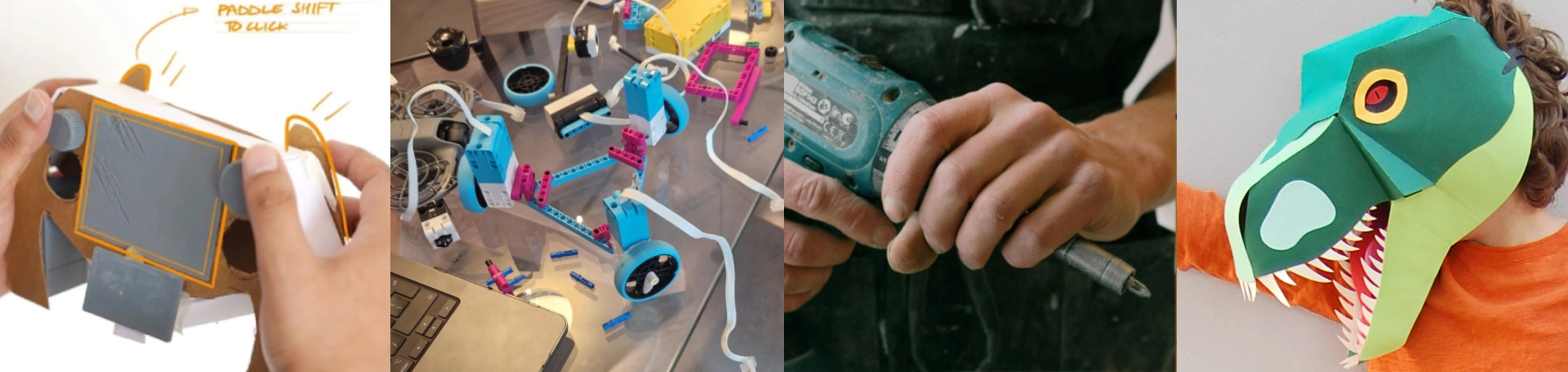
Every programme follows the same three-phase pathway. Every one is tailored individually. None of them look like standard tuition.
This is a specialist practice that has developed over twenty years in the field — across PRUs, special schools, EOTAS placements, and kitchen tables. Every programme is built on the Clearspace framework: interest-led, strength-based, hands-on, and grounded in relationship and trust.
We specialise in STEAM subjects — Maths, Science, Design & Technology, Engineering, Computing, Art & Design, and Drama. For whole-curriculum provision, we work with a carefully chosen network of trusted practitioners who deliver English, PSHE, Music, PE and other subjects within the same framework and philosophy.
(Re)engagement
Meeting them where they are. Building the relationship before anything academic is attempted. Finding what they care about. Creating the conditions where they can show up.
Stabilisation
Developing confidence, regulation and real capability through making. Consistent structure. Growing independence. Skills building through projects that matter to them.
Progression
Academic achievement, qualifications, transitions — whatever comes next. Cross-curricular rigour woven in. GCSE preparation, Functional Skills, or alternative pathways.
Some young people arrive at stage two or three. We always start where they are.
Every Clearspace programme is built around self-directed, project-based learning — cross-curricular, interest-led, strength-focused, and bespoke to the individual. The project is the vehicle. The learning happens inside it.
A single robotics project, for example, involves computational and algorithmic thinking, hands-on experimentation and iteration, collaborative working and communication, self-regulation and executive functioning, ethics and social impact. It could extend into technical writing, research essays, presentation skills.
It scales from age 7 to 16+, from coding blocks to Python to interfacing with AI. Academic rigour — critical thinking, analysis, evaluation — is woven in from the start, not bolted on at the end.
The same work that builds a robot can contribute to:
The learning is integrated. The accreditation follows.
All programmes are adaptable — most can be delivered 1:1, some are enhanced by small groups. All can be designed to work alongside therapists' recommendations and integrated into EHCP targets.
Robotics: Missions & Explorations
Build, code and race robots. From BBC micro:bit to Lego Spike Prime to custom builds. Engineering thinking, coding fundamentals, systems analysis — all through missions that give every build a purpose and a context. Progression runs from block-based coding through Python to AI integration.
Product Design & Making
From sketch to prototype. The full design process — brief, research, ideation, modelling, making, testing, evaluation. 3D printing, CAD, woodwork, materials exploration, mechatronics, cosplay builds. Could be a piece of furniture, a prop, a mechanism, a wearable — whatever connects to the young person's world.
Games Design & Coding
Creative computing for young people who learn best when they're building something they'd want to use. Game design frameworks, website builds, digital products. Scratch and Tinkercad for foundations, progressing through code blocks to Python. Independence skills developed through managing a digital project from concept to delivery.
Engineering Challenges
Challenges that develop engineering thinking and executive function — and can be delivered in a therapeutic, collaborative way. Marshmallow and spaghetti bridges. Giant Meccano towers and go-karts. Cardboard chairs. Lego Spike Prime missions. Scaled from single sessions to multi-week projects, from 1:1 to small groups, from light engagement to deep technical analysis. Used for team building, communication, and — when working alongside occupational therapists — as a framework for developing regulation and motor skills.
21st Century Design Challenges
Solutions to real-world problems. Climate change, sustainability, social design, community challenges — open-ended briefs inspired by the Dyson approach to engineering: identify a problem, understand it deeply, design a solution, build it, test it, improve it. Deliberately ambitious — because young people rise to genuine challenge when they believe the problem matters. Cross-curricular potential spanning science, geography, ethics, economics, communication, and technical writing.
Embodied Maths & Science
Maths and science designed specifically for neurodivergent minds. Hands-on, movement-based, grounded in real-world application. Perpetual motion machines, bridge loading experiments, chemical reactions you can see and feel. Mathematical concepts taught through making, measuring, and physical manipulation — not abstract instruction. This isn't a concession to difficulty. It's a more effective route to genuine understanding.
Art & Design
Drawing and painting — traditional skills taught properly. Digital art and graphic design. Photography. Cosplay design and build. Graffiti art. The creative disciplines aren't a break from STEM — they're the other half of STEAM. Technically rigorous, personally expressive, and connected to the same project-based framework. Leads to GCSE Art & Design, portfolio development, and creative career pathways.
Exam Focus
Study techniques, revision strategies, exam preparation — tailored to neurodivergent learners. Understanding how your brain works under pressure, finding revision methods that actually stick, building the executive function skills that make exam performance possible. Time management, retrieval practice, active recall, anxiety management, and the practical logistics of sitting an exam when your neurology makes that difficult.
Real credentials. Earned through real work.
Entry Level 1–3
Foundation level across core subjects. Starting points for young people with significant gaps.
Functional Skills
Level 1 and Level 2 in Maths and English. Practical qualifications with real currency.
GCSEs & equivalent
Full GCSE preparation across Maths, Science, Art & Design, D&T. NCFE and OCR Nationals in Computing and Media.
AQA Unit Awards & ASDAN
Flexible, project-based accreditation at every level. Ideal for young people for whom traditional exam formats don't work.
Clearspace specialises in STEAM — but with our network of trusted colleagues, we can deliver whole-curriculum provision using the National Curriculum as a map. English, PSHE, Music, PE, MFL and other subjects are delivered by specialist practitioners who share our philosophy and work within the same framework.
This is particularly valuable for EOTAS placements and young people with spiky profiles — where the curriculum needs to be broad but the delivery needs to be individually tailored. Every practitioner in the network is vetted, DBS-checked, and aligned to our safeguarding standards.
CLEARSPACE DELIVERS
Maths · Science · Design & Technology · Engineering · Computing · Art & Design · Drama
NETWORK DELIVERS
English · PSHE · Music · PE · MFL · and other subjects as required
The National Curriculum is the map. Real-world skills are the territory.
Tell us about your young person and we'll suggest what works. Every programme is adapted — nothing is off the shelf.